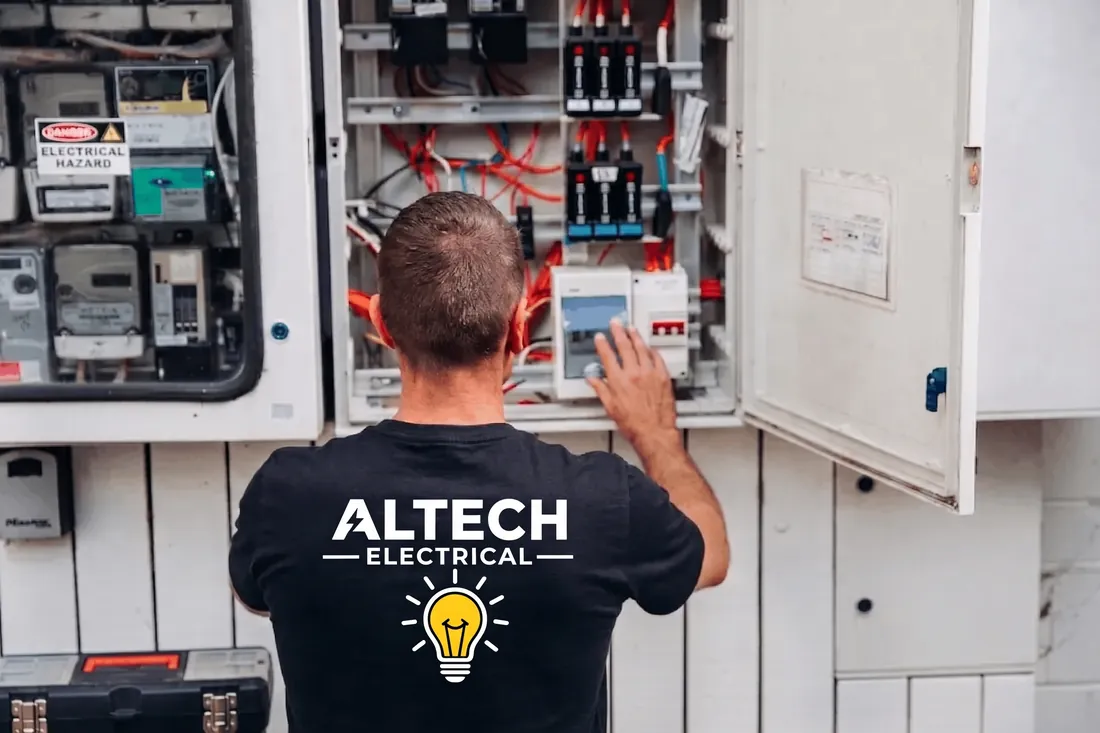
Switchboard Upgrades
Why Your Old Switchboard Is Working Overtime
Most older switchboards were built for a few lights, a fridge and a TV. Today’s homes run ducted air con, ovens, pool pumps and a small army of chargers.
Asking an old fuse box to carry all that is like towing a caravan with a ride on mower. It might move, but it won’t be pretty.
Warning signs your switchboard needs attention
Your switchboard usually tells you when it’s struggling. You just have to know what to look for.
- Ceramic fuses or fuse wire instead of switches
- Power trips when the oven and air con run together
- Lights flicker or dim when a big appliance starts
- A burning smell, scorch marks or discoloured fuse holders
- Buzzing, crackling or sparking from the board
- The board or its cover feels warm to touch
- No safety switches on some or all circuits
- An old meter panel that may contain asbestos
- A defect notice from Ausgrid about your installation
Spot even one of these? Book an inspection before it turns into a weekend without power.
Tip: never swap blown fuse wire for a thicker wire. A thicker wire won’t melt when it should, so the circuit can overheat instead.
Our switchboard upgrade guide covers the signs, ceramic fuses and what an upgrade involves.
Old fuse box vs modern switchboard
Here’s the difference in plain terms.
| Feature | Old ceramic fuse box | Modern switchboard |
|---|
| Shock protection | None | Safety switches (RCDs) cut power in a fraction of a second |
|---|
| Overload protection | Fuse wire melts and must be rewired by hand | Circuit breaker trips and resets with a flick |
|---|
| Finding a fault | Guesswork with a torch | Clearly labelled circuits |
|---|
| Room to grow | Few spare spaces | Space for new circuits |
|---|
| Insurance and sale | Can raise questions | Shows a safe, tested installation |
|---|
A fuse that still works isn’t the same as a fuse that keeps you safe. Ceramic fuses guard against overload, but they do nothing to stop an electric shock.
RCD, RCBO or circuit breaker: what’s the difference?
These three get mixed up all the time, so here’s the short version.
| Device | What it protects against | Think of it as |
|---|
| Circuit breaker | Overloads and short circuits | The bouncer who stops the crowd getting too big |
|---|
| RCD (safety switch) | Current leaking to earth, which causes shocks | The lifeguard watching for trouble |
|---|
| RCBO | Both, in one device on a single circuit | The bouncer and the lifeguard in one |
|---|
A modern board uses these devices together. I’ll explain which ones suit your home when I quote.
The hidden fire and insurance risk
Loose connections, worn fuse holders and overloaded circuits all create heat. Heat inside a switchboard is how a small fault becomes a big problem.
Insurers may ask about the condition of your wiring after a claim. It’s worth checking your policy, and it’s one more reason to keep your board up to date.