
What is the difference between an RCBO and an RCD?
An RCD trips on earth leakage, which protects people from electric shock. An MCB trips on overcurrent, which protects the cable. An RCBO does both jobs in one device, so a single module protects one circuit against both kinds of fault.
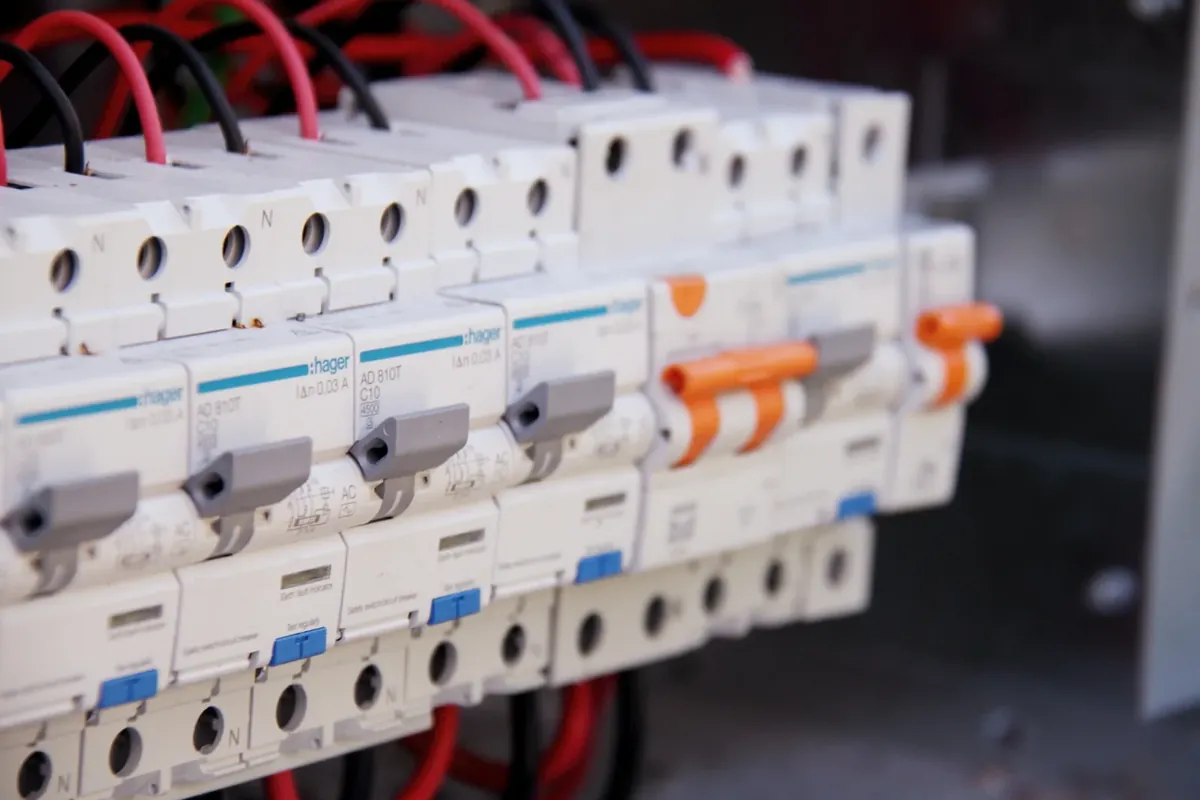
The three devices side by side
| MCB | RCD | RCBO | |
|---|---|---|---|
| Full name | Miniature circuit breaker | Residual current device | Residual current breaker with overcurrent |
| Trips on | Overcurrent and short circuits | Earth leakage | Both |
| Protects | The cable and the connected equipment | People, from electric shock | Both |
| Does not protect | People, from electric shock | Cables, from overcurrent | - |
MCB: the overcurrent device
A miniature circuit breaker protects the cable and the load from overcurrent and short circuit faults. If the current stays above its rating for long enough, it opens. If a short circuit pulls a very high current, it opens at once.
An MCB does not react to earth leakage. Current flowing to earth through a person can be far below the level that trips it.
RCD: the earth leakage device
An RCD measures the current going out on the active and coming back on the neutral. If the two do not match, current is going to earth somewhere, through a faulty appliance, damaged insulation or a person. The RCD then opens within milliseconds.
An RCD does not react to overcurrent. An overloaded cable can overheat while the active and neutral currents still balance.
RCBO: both in one module
An RCBO opens on overcurrent like an MCB and on earth leakage like an RCD. There are two common ways to lay out a board:
- An RCBO on each circuit: a fault on the oven trips the oven only, and the lights stay on. It is simpler to find a fault, and it costs more per circuit.
- One RCD covering a group of MCBs: fewer devices on the board, but a single earth fault drops every circuit in the group.
Type A and Type AC
RCDs and RCBOs also come in types. A Type AC device trips on AC residual currents only. A Type A device trips on AC and on pulsating DC residual currents. Your electrician selects the type to suit the circuit and the equipment on it.
For the basics, start with our guide to safety switches.