
What is a safety switch?
A safety switch, also called an RCD, is a device on your switchboard that protects people from electric shock. It watches the flow of electricity all the time and turns the power off within milliseconds when it detects current leaking. Circuit breakers and fuses do a different job: they protect the wiring.
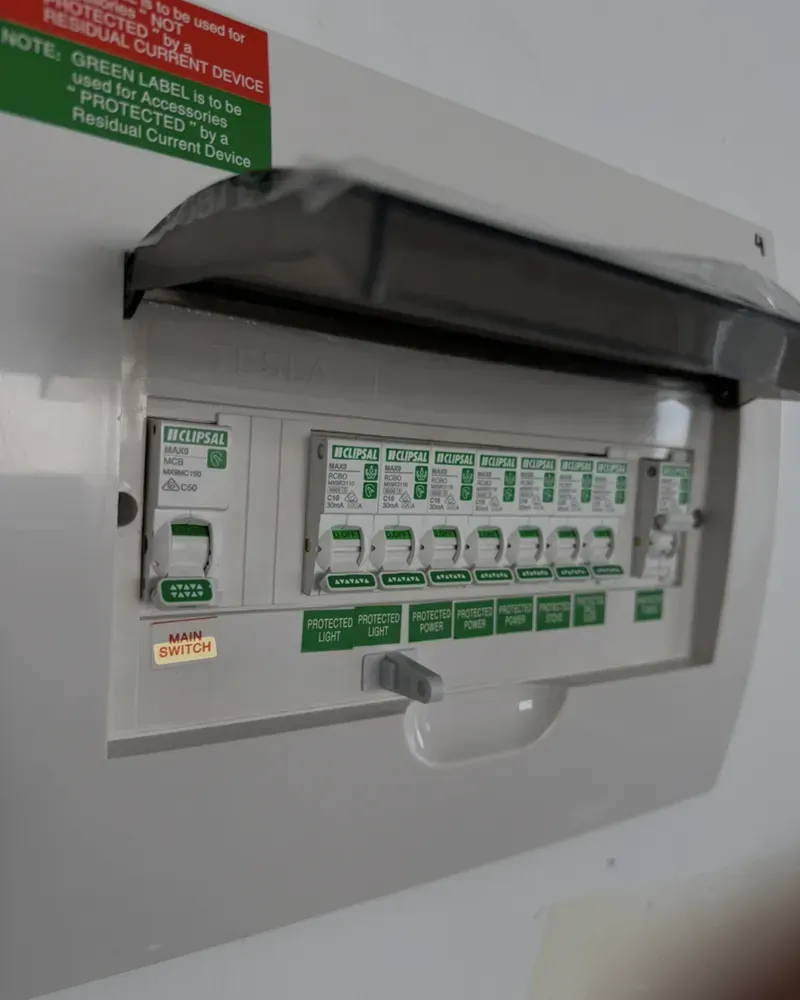
What a safety switch does
Electricity is invisible, so you cannot see the danger. A safety switch monitors the flow of electricity continuously and cuts the power the instant it detects an unsafe situation.
A current leak can happen when a faulty power point, faulty wiring or a faulty appliance is being used. Without a safety switch, that leaking current can pass through a person. With one, the power is off in a split second.
A safety switch only protects you if two things are true. It has to be working properly, and it has to be connected to the circuit that has the fault.
Safety switch, circuit breaker or fuse?
The three are often mistaken for the same thing. They are not, and the difference matters.
| Safety switch | Circuit breaker or fuse | |
|---|---|---|
| Protects | People, from electric shock | The circuit and its wiring |
| Acts when | A current leak is detected | Too much current flows through the wiring |
| Why it matters | Stops a serious shock | Stops wiring and appliances overheating and starting a fire |
Circuit breakers and fuses do not protect people directly. That is the job of the safety switch. Our page on RCBOs, RCDs and MCBs explains the devices that combine both jobs.
How to tell if you have a safety switch
The easiest check is at the switchboard.
- Look for a test button: a safety switch has a button marked "T" or "test".
- Look carefully: there may be more than one, and the buttons can be blue, white, black or orange in different shapes and sizes.
- Check the labels: every switch on the board should be labelled so it is easy to identify.
- Separate or combined: a safety switch can be its own item on the board or part of a circuit breaker.
If nothing on the board has a test button, you may have circuit breakers or fuses only. Ask a licensed electrician to check whether your home is protected.
Why one safety switch may not be enough
A safety switch only protects the circuit it is fitted to. A board can have many circuit breakers and a single safety switch that covers just the power points.
That leaves the other circuits without shock protection. It is worth considering safety switches on all circuits, including:
- power points
- lighting
- air conditioning
- the stove or oven
- hot water
- pool equipment
An electrician can add safety switches to the switchboard to cover those circuits. There are different ratings and types for different circuits, and your electrician can advise which you need.
Testing your safety switch
A safety switch saves lives only if it works, so test each one every three months. Pressing the test button simulates an unsafe situation, and a working switch flicks to off straight away.
After the test, check which lights and appliances have lost power. Anything still running is not protected by that switch. Our step-by-step page shows how to test a safety switch.
When a safety switch keeps tripping
A switch that trips is doing its job, but regular trips point to a problem that needs finding. See why a safety switch keeps tripping for the usual causes.
Installation is a job for a licensed electrician
Only a licensed electrician should install a safety switch or add one to a switchboard. If you are unsure which circuits are protected, or a switch fails its test, see our safety switch installation service.