
What types of EV chargers are there for home?
Most EVs come with a Level 1 lead that plugs into a power point, which charges slowly. A Level 2 charger is a dedicated unit mounted on a wall or pedestal that charges at up to 7 kW on single phase power or 22 kW on three phase. Chargers also differ in their cable, their smart features and where they can be installed.
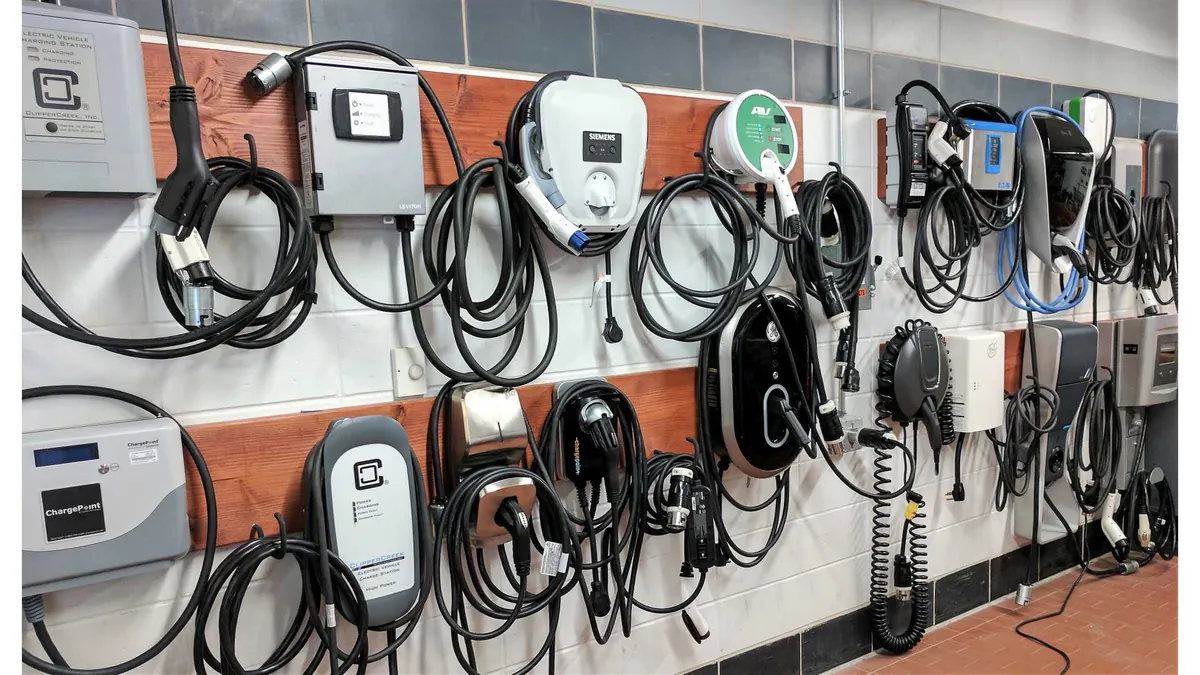
Level 1 and Level 2 chargers
| Level 1 lead | Level 2 charger | |
|---|---|---|
| What it is | A lead supplied with most EVs | A dedicated charging unit |
| Where it connects | A standard power point | Mounted on a wall or pedestal |
| Charging speed | Slow, especially for a large battery | Up to 7 kW single phase or 22 kW three phase |
Single phase or three phase
Most homes have single phase power, where 7 kW is the highest charging rate without upgrading to three phase. Homes with three phase power can charge at up to 22 kW. Our complete guide to home EV charger installation explains when an upgrade makes sense.
Tethered or untethered
- Tethered: the cable is fixed to the charger and rolls back onto it after use.
- Untethered: the charger has a socket and works with any compatible cable. That suits shared use or swapping cables.
Smart features
Many chargers offer more than charging:
- Smart charging: uses off-peak power and solar energy.
- Load balancing: lowers the charging rate while other appliances such as the kettle, dryer and oven are running, then speeds up again.
- App monitoring and control: real-time data, charging history, scheduling and remote control.
- Security: RFID cards and app security for shared chargers.
A solar-compatible charger can use excess solar energy to charge the car instead of exporting it. Your electrician installs current transformer (CT) clamps so the charger can see your solar output.
Plug types
Most EVs in Australia use the Type 2 plug, which handles AC charging at home. Public DC fast charging uses the CCS version of the Type 2 plug, which adds two pins. Some older EVs use a Type 1 plug. CHAdeMO, a Japanese plug used for DC charging on some EVs, is being phased out.
Where you park
A charger installed outside needs a strong IP rating so it is weather-sealed. If the car parks some distance from the charger, longer cables, cable arms, retractable and coiled cables can reach the charging port. To see what charging adds to your power bill, read how much it costs to charge an electric car at home.