
What is involved in installing a bathroom exhaust fan?
Installing a bathroom exhaust fan means choosing a fan that suits the room, fitting it in the ceiling, wall or roof space, wiring it in and, in most cases, ducting it to the outside. In a bathroom without a window, the fan is usually linked to the light switch with a run-on timer. Hardwired fans must be installed by a licensed electrician.
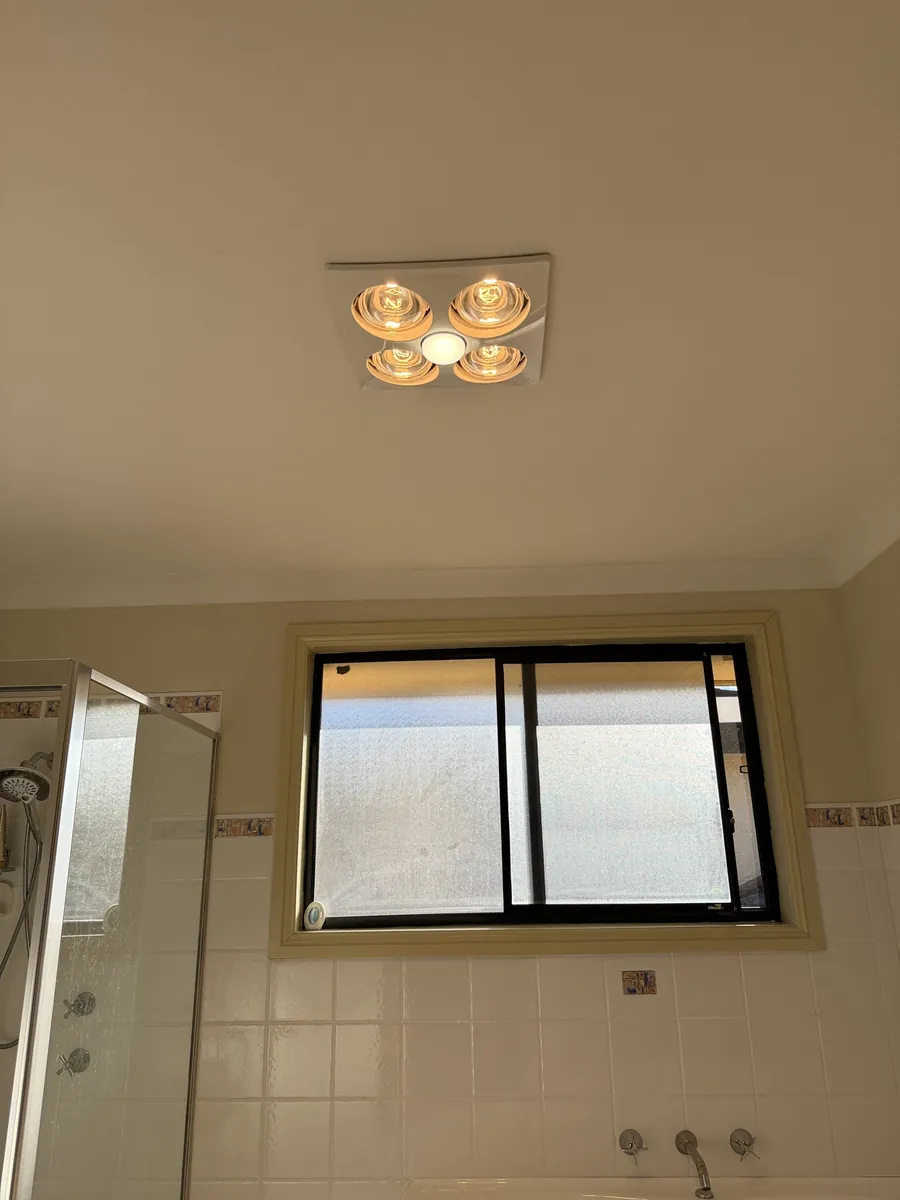
Why bathroom ventilation matters
Poor ventilation is a common cause of mould in bathrooms. When steam from a shower has nowhere to go, it condenses on ceilings, walls, mirrors and window frames and creates the damp conditions mould needs. Over time that leads to stained ceilings, peeling paint, failing grout and, in bad cases, damage to the ceiling plaster and timber framing. Poor ventilation can also aggravate asthma and allergies.
A well-installed exhaust fan removes steam and moisture before it soaks into the ceiling, walls and grout.
Types of exhaust fan
| Fan type | Suits | Ducting |
|---|---|---|
| Ceiling-mounted | Small to medium bathrooms with roof access | Recommended |
| Inline ducted | Bathrooms far from an outside wall or roof, and long duct runs | Part of the system |
| Wall-mounted | Rooms with an outside wall, laundries and garages | Vents straight through the wall |
| 3-in-1 heat, light and exhaust | Bathrooms that need heating as well as ventilation | Recommended |
| Window-mounted | Kitchens and older bathrooms with window access | Not needed |
An inline ducted fan is quieter because its motor sits away from the room. Our page on choosing a bathroom exhaust fan covers placement and airflow.
Ducting to the outside
Ideally, an exhaust fan vents to the outside rather than into the roof space. Venting into the roof pushes warm, moist air into the ceiling insulation and timber framing, which can cause condensation, mould and long-term damage. The National Construction Code requires exhaust systems in new homes to discharge to the outside, directly or through a duct. In an existing home, ducting can be added from the current fan through the eaves, soffit or roof. For the detail, see whether bathroom exhaust fans need to be vented outside.
Bathrooms without a window
For a bathroom without a window, the National Construction Code requires mechanical ventilation that either runs continuously or is linked to the light switch with a run-on timer. The timer keeps the fan running for at least 10 minutes after the light is turned off.
How much extraction a bathroom needs
As a general rule, a standard bathroom fan should extract at least 25 litres per second. Larger bathrooms, and those with a spa bath, may need a higher capacity fan. The room size decides the right capacity.
Kitchens and laundries
Kitchen exhaust fans and rangehoods remove cooking fumes, grease and steam at the source, and kitchens need a higher extraction rate than bathrooms. Laundries also produce a lot of moisture, especially from dryers that are not vented outside. A laundry exhaust fan stops condensation building up on windows and walls.
Replacing a noisy or weak fan
If your fan is noisy, rattling, pulling weakly or has stopped working, replacing it is usually better value than repairing it. A noisy fan usually means worn bearings or a failing motor. Modern fans are quieter, more energy efficient and often extract more air. The old fan is removed, the wiring and ducting are checked, and the new fan is fitted to the existing cut-out where possible.
Do you need an electrician?
Yes, for a hardwired fan. Hardwiring an exhaust fan is electrical work and must be done by a licensed electrician, whether it is a new installation, a replacement or a swap that changes the wiring. Plug-in fans do not need an electrician.
When to call a licensed electrician
Call a licensed electrician for a new fan, a replacement, a run-on timer or ducting a fan to the outside. For help, see our exhaust fan installation service.