
What is involved in installing a ceiling fan?
Installing a ceiling fan means fixing the fan bracket to a suitable ceiling support, attaching the motor and completing the electrical connections to Australian standards. The electrician then sets up the wall switch or remote, balances the fan so it runs quietly and tests it. If the mounting or wiring is wrong, the fan can wobble, get noisy or develop an electrical fault.
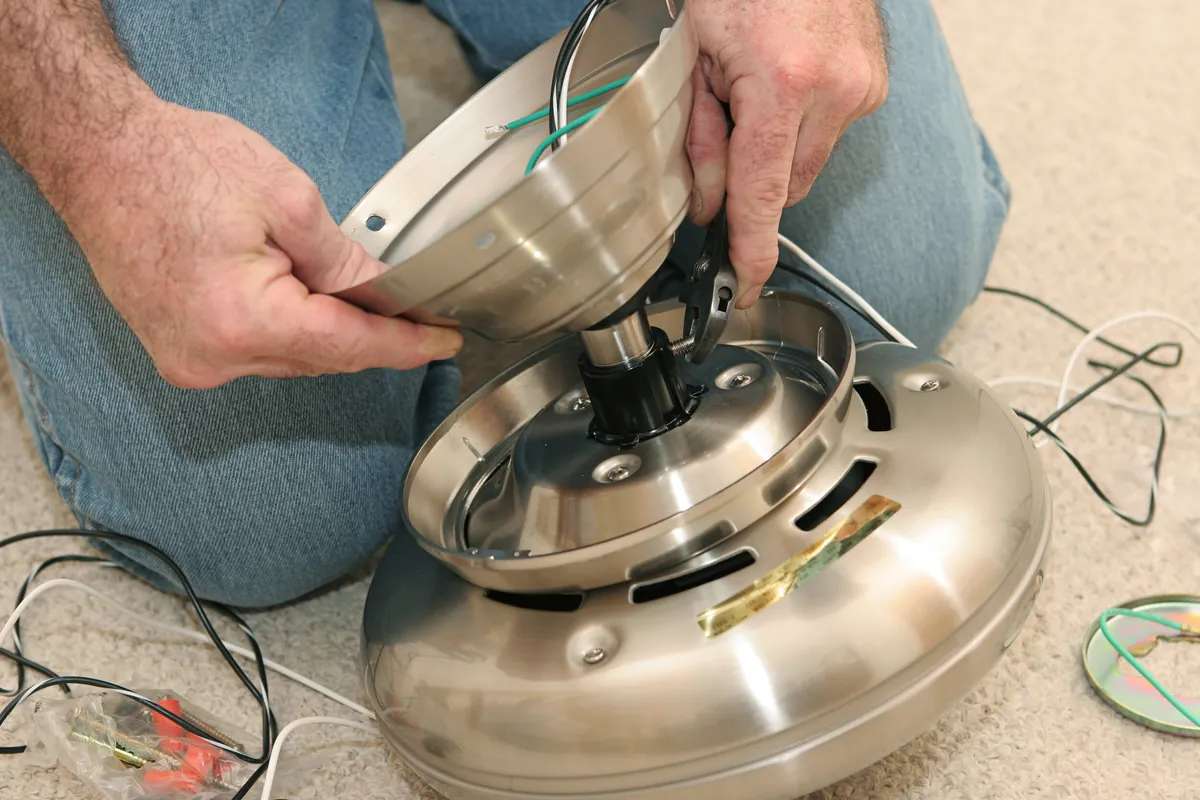
The steps in a ceiling fan installation
A standard installation suits rooms with flat ceilings and existing wiring, and is one of the most common jobs in bedrooms, living areas and home offices. It generally runs like this:
- Remove the existing light fitting or old fan.
- Install a secure bracket fixed to a suitable ceiling support.
- Attach the fan motor and complete the electrical connections.
- Wire the fan to a wall switch or set up the remote.
- Balance the fan so it runs without noise, then test it.
Every installation should comply with the Australian wiring standard, AS/NZS 3000.
Types of ceiling fan
Fans differ in their motor, profile, blades and where they can go:
- Low profile: flush-mount or hugger fans give safe clearance where ceilings are low, such as older homes, units, bedrooms and garages.
- DC motor: very quiet and generally more energy efficient than a traditional AC fan, depending on the manufacturer's figures, which suits bedrooms, nurseries and offices. They are usually set up with a remote or wall control.
- AC motor: a widely used, cost-effective option operated from a wall switch, common in homes, garages and rental properties.
- Three, four or five blades: each design gives a different mix of airflow and noise. Whatever the count, the fan needs to be mounted securely and balanced to stop wobble.
- Fan with light: combines a fan and an LED light, often dimmable or with adjustable colour temperature. It needs separate control for the fan and light, either through dual wiring or a remote.
- Retractable blade: looks like a light fitting when off, with blades that extend while it runs. It suits dining and living areas.
- Outdoor: a weatherproof, IP-rated fan for covered alfresco areas, patios, pergolas and balconies, mounted securely and wired to keep moisture out.
Controls: wall switch or remote
A remote control makes it easy to change speed, direction and lighting. It is especially handy in rooms with high ceilings, or bedrooms where the wall switch is hard to reach. A remote kit can be added to a new or existing fan, as long as it suits the model and the receiver is wired correctly.
Choosing the right size
Ceiling fans come in a range of blade diameters, commonly from 112 cm to 142 cm. As a general rule, a larger diameter circulates more air. For most bedrooms, a fan of 122 to 132 cm moves enough air without overwhelming the room. Large living areas and open-plan spaces usually suit 132 to 142 cm. Ceiling height, layout and furniture placement also affect the right choice, and the manufacturer's specifications for the fan you pick should always be checked. Our page on ceiling fan size and clearance explains how to check a fan will fit.
Replacing an existing fan or light
Replacing an old fan or light with a new ceiling fan is a common job, and it is usually quicker and cheaper than installing a fan in a new spot, as long as the existing wiring is in good condition. During the swap, the electrician checks the mounting point, the wiring and the switch to make sure the new fan will run safely.
Why the mounting matters
Correct mounting is essential for safety, performance and long-term reliability. The bracket has to be fixed to a suitable ceiling support before the motor goes on and the connections are made. A fan attached incorrectly can wobble, make noise or develop electrical faults, which is why professional installation is strongly recommended.
Fans you have bought yourself
An electrician can install a fan you have bought online or in store, including the mounting, wiring and testing. Having it installed properly helps meet the manufacturer's warranty conditions and electrical safety rules, so check the warranty terms for your fan.
Why choose a ceiling fan
A ceiling fan cuts your reliance on air conditioning, which helps lower energy bills. In winter, many fans can run to push warm air down into the room. Fans are energy efficient to run, and they come in styles and sizes to suit most rooms.
When to call a licensed electrician
Call a licensed electrician for any new fan, replacement or remote upgrade. Installing a ceiling fan is not a DIY job, as our page on whether you can install a ceiling fan yourself explains. For help, see our ceiling fan installation service.